
Cycle Syncing your Diet: What to Eat in Each Phase
Jul 07, 2026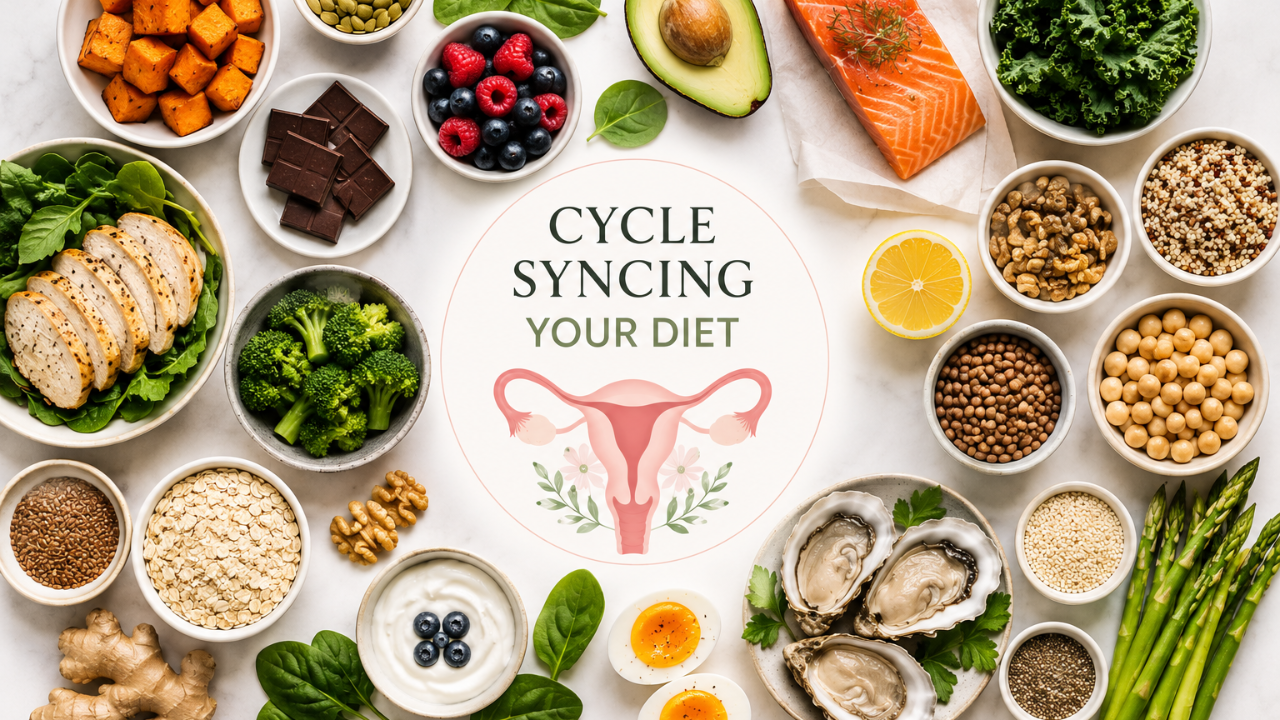
You're not the same person every week of the month, and your nutrition shouldn't be either.
If you've ever noticed that some weeks you feel sharp, energized, and completely in control of your cravings, and other weeks you're exhausted, ravenous, and reaching for every carb in sight: you're not imagining it. Your hormones shift dramatically across the four phases of your cycle, and those shifts have a direct impact on how your body processes blood sugar, what fuels it best, and how well it can support ovulation and fertility.
Most nutrition advice treats your body like a constant. Eat this way, always. But your cycle tells a different story, and when you learn to listen to it, managing blood sugar and supporting hormone health becomes a lot more intuitive and a lot less exhausting.
Why blood sugar and your cycle are more connected than you think
Here's the mechanism worth understanding: insulin, the hormone your body releases to manage blood sugar after eating, doesn't operate alone. It interacts directly with your reproductive hormones, particularly estrogen and progesterone. When blood sugar is unstable, insulin spikes, and those spikes can amplify androgenic hormones (like testosterone), suppress ovulation, and throw off the hormonal flow that makes each phase of your cycle function the way it’s meant to.
The good news? You can use food strategically at each phase to keep blood sugar steady, work with your shifting hormones, and give your body the specific nutrients it needs to move smoothly from one phase to the next.
Eating for each phase of your cycle
Phase 1 · Menstrual (Days 1–5): restore and replenish
Estrogen and progesterone are both at their lowest, energy dips, inflammation can climb, and your body is doing the real, physical work of shedding the uterine lining. This is not the week to restrict — it's the week to nourish.
Low hormones plus low energy make you especially sensitive to blood sugar swings, so warm, mineral-rich meals do a lot of heavy lifting right now. Iron, omega-3s, and magnesium help ease cramping, steady your mood, and keep your energy from bottoming out — all without spiking insulin.
Try this instead: Rather than skipping meals because you feel off, start the day with a warm, protein-rich bowl — think ground beef, roasted sweet potato, and sautéed spinach. It replenishes the iron you're losing and keeps blood sugar from crashing.
Foods to lean on: grass-fed beef, dark leafy greens, salmon, lentils, pumpkin seeds, bone broth, and dark chocolate (heck yes).
Phase 2 · Follicular (Days 6–14): build and energize
As estrogen rises to prepare for ovulation, most women hit their stride — energy is highest, mood lifts, and insulin sensitivity improves. Your body handles carbohydrates more efficiently right now than at any other point in your cycle.
That makes this the ideal window to bring in slightly more complex carbs without the usual spike-and-crash. Pair them with lean protein, and add probiotic-rich foods to support estrogen metabolism through the gut — an often-overlooked piece of hormonal health.
Try this instead: Instead of a plain bowl of oats, cook them with a scoop of protein powder, or top them with a soft-boiled egg and seeds. The protein blunts the blood sugar response and keeps your energy steady straight through the morning.
Foods to lean on: eggs, quinoa, fermented foods, berries, broccoli, flaxseeds, and chicken.
Phase 3 · Ovulatory (Days 15–17): support the main event
Estrogen peaks, luteinizing hormone surges, and — if all systems are go — ovulation happens. This is the window that matters most for fertility, and it needs robust nutritional support for that hormonal surge to go smoothly.
Here's the catch: a blood sugar spike right around ovulation can interfere with the LH surge and blunt the release of an egg. So anti-inflammatory foods, zinc, and B vitamins earn their spot this week. Keep meals balanced, and whatever you do, don't skip the healthy fats — they're essential for hormone production.
Try this instead: Instead of a fruit-heavy smoothie, build one on protein powder, spinach, avocado, and just a small amount of fruit. The fat and protein head off the blood sugar spike that could undermine the exact conditions ovulation depends on.
Foods to lean on: oysters and shellfish, avocado, leafy greens, sunflower seeds, wild salmon, and asparagus.
Phase 4 · Luteal (Days 18–28): calm and prepare
Progesterone climbs to prepare the uterine lining for a possible implantation, and this is when PMS, cravings, bloating, and mood swings tend to show up. It's also when blood sugar dysregulation is most disruptive: insulin resistance is naturally a bit higher in the luteal phase, so spikes hit harder and the crash feels worse.
This is where your nutrition strategy earns its keep. Leaning on complex carbohydrates paired with protein and fat, eating a little more frequently, and working in magnesium- and B6-rich foods can dramatically soften PMS, cravings, and the emotional swings that come from progesterone's effect on blood sugar.
Try this instead: Instead of writing off that afternoon craving, reach for a balanced snack — apple slices with nut butter and a small square of dark chocolate. It satisfies the craving, steadies your blood sugar, and delivers magnesium to calm your nervous system.
Foods to lean on: sweet potato, turkey, chickpeas, walnuts, sesame seeds, banana, and dark chocolate.
Struggling with the luteal-phase spiral?
Our PMS Survival Guide, created by our functional-medicine-trained dietitians, covers the foods that help (and the ones that don't), nervous-system-calming strategies, endocrine disruptors to skip, plus a PMS recipe guide and a symptom-tracking workbook. Everything you need to work with your cycle instead of dreading half of it.
→ Get the PMS Survival Guide — $47
What happens when you ignore the cycle-blood sugar connection
When blood sugar stays dysregulated across months and years, the cumulative hormonal disruption compounds. Ovulation becomes inconsistent or absent. PMS symptoms intensify. The luteal phase shortens, which reduces the window for implantation. For women trying to conceive, this is one of the most under-addressed contributors to unexplained infertility. And for women not actively trying, a dysregulated cycle is a warning sign that something systemic needs attention before it becomes harder to reverse.
When cycle nutrition alone isn't enough
Cycle syncing your diet is a powerful starting point, but if you've been eating well and still dealing with irregular cycles, missing ovulation, relentless luteal phase cravings, or PMS that feels unmanageable, there's likely more going on beneath the surface.
True insulin resistance, elevated androgens, thyroid dysfunction, and gut imbalances all interfere with cycle health in ways that diet tweaks alone can't fully address. Getting a full hormonal and metabolic picture, not just a fasting glucose, is often the difference between spinning your wheels and actually making progress.
At Family Nutrition Solutions, we look at the full picture: your labs, your symptoms across each phase, your relationship with food, and the root causes driving your cycle patterns. We build a personalized plan that accounts for your specific hormonal landscape, not a generic protocol.
Ready to stop guessing? Request an appointment with one of our dietitians.